
Showing posts with label The Pain Scale. Show all posts
Showing posts with label The Pain Scale. Show all posts
Monday, September 19, 2011

Importance of Allusions
"In the second circle of Dante's Inferno, the adulterous lovers cling to each other, whirling eternally, caught in an endless wind. My next-door neighbor who loves Chagall, does not think this sounds like Hell. I think it depends on the wind" --Eula Biss, "The Pain Scale"
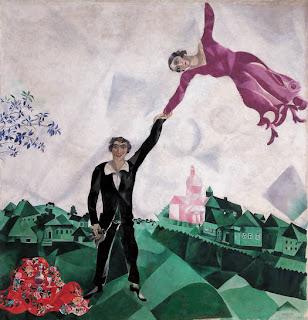
"We float like two lovers in a painting by Chagall" --The Weepies, "Painting by Chagall"
"I think it depends on the wind"

The infernal hurricane that never rests
Hurtles the spirits onward in its rapine;
Whirling them round, and smiting, it molests them.
When they arrive before the precipice,
There are the shrieks, the plaints, and the laments,
There they blaspheme the puissance divine.
I understood that unto such a torment
The carnal malefactors were condemned,
Who reason subjugate to appetite.
And as the wings of starlings bear them on
In the cold season in large band and full,
So doth that blast the spirits maledict;
It hither, thither, downward, upward, drives them;
No hope doth comfort them for evermore,
Not of repose, but even of lesser pain."
--Dante's Inferno, Canto V, lines 31-45
"The description of hurricane-force winds on the Beaufort scale is simply 'devestation occurs'"
--Eula Biss, "The Pain Scale"
Friday, September 16, 2011
The Pain Scale--Class Notes and a preliminary interpretation

Today in class, we read "The Pain Scale" by Eula Biss. This is an interesting piece--a prose piece that reads more like poetry. The very first adjective we came upon for this piece was "weird" (in BOTH classes!). I understand that. The piece does not easily fit into a genre. Is it fact? Is it fiction? Is it autobiography? Perhaps all of these things?
My students described the piece's tone as "thoughtful." I think that this is the mode of the piece. It is a kind of figurative exploration of pain and measurement. I think the tone wavers between a kind of "objective" fact checking and doubt. Biss will claim something, but then immediately put it into question. For instance, when she discusses the Christianity that is not hers, it seems that she is critiquing that religion. Indeed, she does seem to be critiquing the idea that "pain is holy." Biss instead takes comfort in the idea "This too shall pass," a phrase taken from the bible. This phrase, these words, become "holy" to Biss (181).
BUT WAIT! Is this phrase in the bible? A simple google search will reveal a controversy over these very words: http://wiki.answers.com/Q/Where_is_this_too_shall_pass_in_the_bible. The way this person explains it is that this is derived from biblical teachings. Hmmm. . .so this is a fiction we've come up with, based on biblical teachings, that help us through life. So why is it in "quotations"? It is not an actual citation from the bible, but a saying, some common wisdom. These words, which are actually not holy in the sense that they were written by God (according to Christian belief in the bible) but rather they become holy for Biss. The secular and the religious mix, just as math mixes with Christ. The point here seems to be that the main "teachings" of religion can help us through life, can even become something we have "faith" in, but has nothing to do with "knowledge" in the strict sense. We do not have to believe in the Christian Mystery to take comfort from "This too shall pass." We do not have to believe suffering is divine. Indeed, this phrase focuses on the transitory nature of existence, like something from Ecclesiastes ("All go unto one place; all are of the dust, and all turn to dust again.").
This sort of indifference to the truth of Christ's birth goes back to the section "0," where Biss writes, "the problem of zero troubles me significantly more than the problem of Christ" (171). In a way, she wants the enigmas to go away, she wants to be able to do something with her knowledge--she wants to measure it. Is this not why we have scales? This divorce between knowledge as Truth (and certainty) and knowledge that helps us deal with life is a theme that permeates the text. She begins this idea here: "I'm sitting in the hospital trying to measure my pain on a scale from zero to ten. For this purpose, I need a zero" (171, italics mine). Thus, zero has a purpose, even if zero is merely an idea. In the same way, we see that Biss does not have to understand calculus in order to use it: " Just as I am incapable of actually understanding calculus although I could once perform the equations correctly" (175).
Perhaps in the same way, we can think of religion as having the purpose of comfort, regardless of whether we understand such biblical mysteries as the immaculate conception or the Holy Trinity. Does zero require a "faith" or can we simply use it? Furthermore, it also seems that Biss its more troubled by the problem of zero than Christ because measuring pain, is something we need to be able to do in order to communicate our need to others (or our feelings to others). It is an immediate demand. The problem of Christ can wait--I still have a bit of time before I need to convert and not go to Hell.
Themes to Explore in "The Pain Scale"
Faith/knowledge
Religion/Christianity
Mind/Body
Dante's Inferno (fiction/truth)
Hot/Cold
Pain/Suffering
Scales
Zero
Mathematics
Autobiography
"Facts"
Duration (Time)
Subjectivity/Objectivity
Practical knowledge/"Truth" knowledge (facts)
Subscribe to:
Posts (Atom)